Declaration of a matrix using dynamic allocation ; we should use a pointer of a pointer.
A linked list : is a linear data structure where each element (called a node) is connected to the next one using pointers. Unlike array, elements of linked list are stored in random memory locations.
What is a Linked List?
A linked list is a sequence of nodes in which each node is made up of two parts:
- **Data**: The value stored in the node.
- **Pointer**: A reference to the next node in the sequence. __(There can be multiple pointers for different kind of linked list.)__
Representation of Linked List in C
In C, linked lists are represented as the pointer to the first node in the list. For that reason, the first node is generally called head of the linked list. Each node of the linked list is represented by a structure that contains a data field and a pointer of the same type as itself. Such structure is called self-referential structures.
Types of Linked List in C
Singly Linked List
A linked list or singly linked list is a linear data structure that is made up of a group of nodes in which each node has two parts: the data, and the pointer to the next node. The last node's (also known as tail) pointers point to NULL to indicate the end of the linked list.
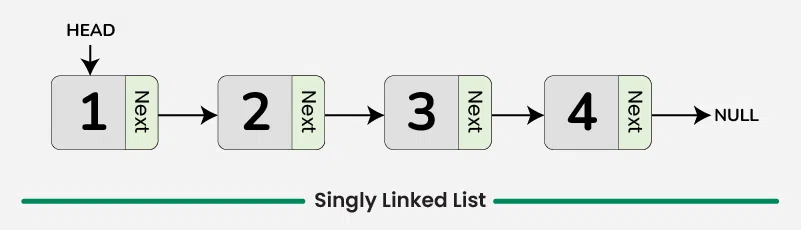
Singly Linked List
Representation of Singly Linked List
A linked list is represented as a pointer to the first node where each node contains:
- Data: Here the actual information is stored.
- Next: Pointer that links to the next node.
// Structure to represent the
// singly linked list
struct Node {

  // Data field - can be of
  // any type and count
  int data;

  // Pointer to the next node
  struct Node* next;
}
Basic Operations on Singly Linked List
| Operation | Operation Type | Description | Time Complexity | Space Complexity |
|---|---|---|---|---|
| Insertion | At Beginning | Insert a new node at the start of a linked list. | O (1) | O (1) |
| At the End | Insert a new node at the end of the linked list. | O (N) | O (1) | |
| At Specific Position | Insert a new node at a specific position in a linked list. | O (N) | O (1) | |
| Deletion | From Beginning | Delete a node from the start of a linked list | O (1) | O (1) |
| From the End | Delete a node at the end of a linked list. | O (N) | O (1) | |
| A Specific Node | Delete a node from a specific position of a linked list. | O (N) | O (1) | |
| Traversal | Traverse the linked list from start to end. | O (N) | O (1) | |
| #### Doubly Linked List |
A doubly linked list is a bit more complex than singly linked list. In it, each node contains three parts: the data, a pointer to the next node, and one extra pointer which points to the previous node. This allows for traversal in both directions, making it more versatile than a singly linked list.
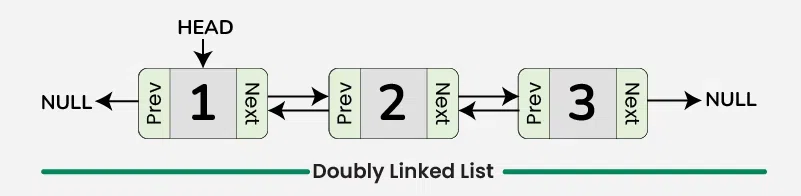
Doubly Linked List
Representation of Doubly Linked List
A doubly linked list is represented as a pointer to the first node (head), where each node contains:
- Data: The actual information stored in the node.
- Next: A pointer that links to the next node in the sequence.
- Previous: A pointer that links to the previous node in the sequence.
// Structure to represent the doubly linked list
struct Node {

  // Data field - can be of any type and count
  int data;

  // Pointer to the next node
  struct Node* next;

  // Pointer to the previous node
  struct Node* prev;
}
Basic Operations on Doubly Linked List
| Operation | Operation Type | Description | Time Complexity | Space Complexity |
|---|---|---|---|---|
| Insertion | At Beginning | Insert a new node at the start of a linked list. | O (1) | O (1) |
| At the End | Insert a new node at the end of the linked list. | O (N) | O (1) | |
| At Specific Position | Insert a new node at a specific position in a linked list. | O (N) | O (1) | |
| Deletion | From Beginning | Delete a node from the start of a linked list | O (1) | O (1) |
| From the End | Delete a node at the end of a linked list. | O (N) | O (1) | |
| A Specific Node | Delete a node from a specific position of a linked list. | O (N) | O (1) | |
| Traversal | Traverse the linked list from start to end or vice versa. | O (N) | O (1) |
Circular Linked List
A circular linked list is a variation of a singly linked list where the last node points back to the first node, forming a circle. This means there is no NULL at the end, and the list can be traversed in a circular manner.
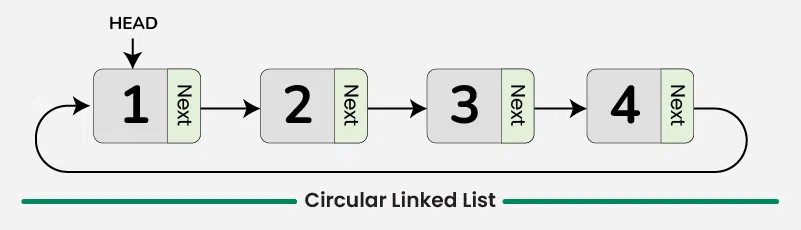
Circular Linked List
The structure of the circular linked list node is same as that of singly linked list.
Representation of Circular Linked List
A circular linked list is represented as a pointer to the first node, where each node contains:
- Data: The actual information stored in the node.
- Next: A pointer that links to the next node, with the last node pointing back to the first node.
// Structure to represent the circular linked list
struct Node {

  // Data field - can be of any type and count
  int data;

  // Pointer to the next node
  struct Node* next;
}
Note: A circular linked list can also be represented by a pointer to the last node.
Basic Operations on Circular Linked List
| Operation | Operation Type | Description | Time Complexity | Space Complexity |
|---|---|---|---|---|
| Insertion | At Beginning | Insert a new node at the start of a linked list. | O (N) | O (1) |
| At the End | Insert a new node at the end of the linked list. | O (N) | O (1) | |
| At Specific Position | Insert a new node at a specific position in a linked list. | O (N) | O (1) | |
| Deletion | From Beginning | Delete a node from the start of a linked list | O (N) | O (1) |
| From the End | Delete a node at the end of a linked list. | O (N) | O (1) | |
| A Specific Node | Delete a node from a specific position of a linked list. | O (N) | O (1) | |
| Traversal | Traverse the linked list from start to end or vice versa. | O (N) | O (1) |
When you want to create a node dynamically, you use malloc:
struct node *n1 = (struct node *)malloc(sizeof(struct node));
This allocates memory for one node and returns a pointer to it.